Futures education
How CME futures orders split a fill at the same price
Two buy orders can be working at the same futures price when a seller trades there, yet only one buyer gets a fill. On CME Globex, a first-in, first-out (FIFO) match gives the earliest bid first claim. A pro rata step divides the available contracts according to how much each order displays at that price.
One seller, three bids at 100.00
Suppose A bids for 4 contracts, then B bids for 8, then C bids for 12. All three are fully displayed at 100.00, the best bid. A seller trades 12 contracts against those 24. Assume these are the only eligible orders and all 12 contracts go straight to the matching step shown.
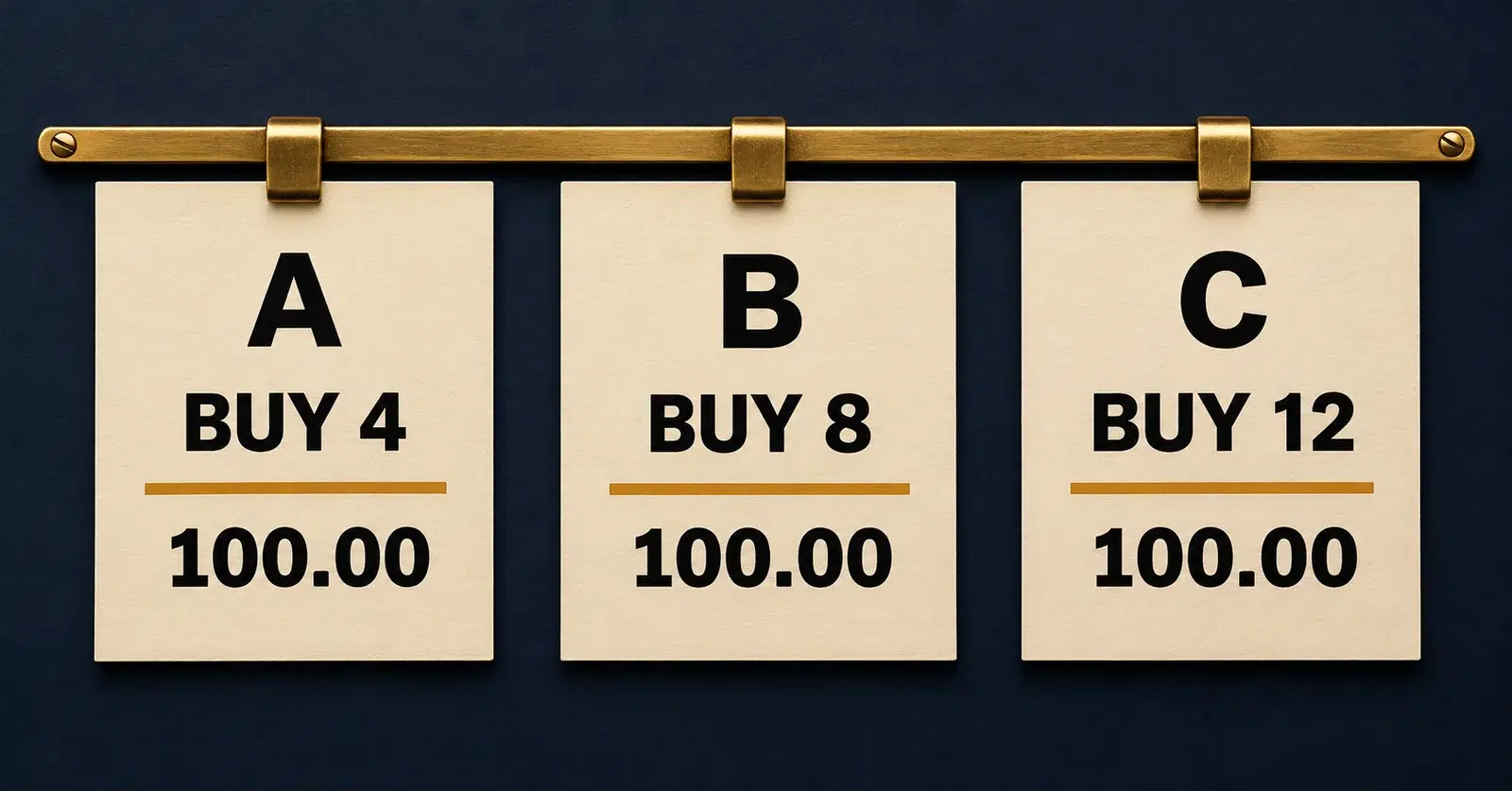
Under FIFO, A takes 4 and B takes the remaining 8. C gets nothing even though a trade prints at its price. Under pro rata with a one-lot minimum, C displays half the bid and gets half the trade. B’s share is 8 ÷ 24 × 12 = 4 contracts.
| Bid in arrival order | Lots displayed | FIFO fill | Pro rata fill |
|---|---|---|---|
| A (first) | 4 | 4 | 2 |
| B | 8 | 8 | 4 |
| C (last) | 12 | 0 | 6 |
Sources: CME Globex matching algorithm steps, minimums and rounding
Where the leftover contracts go
Start again with the original bids, this time with a seller trading 5 lots. A, B and C have proportional shares of 5/6, 1⅔ and 2½ lots. With a one-lot minimum and fractions rounded down, they receive 0, 1 and 2. That allocates only 3 of the 5 contracts.
If FIFO comes next, both leftover lots go to A, the earliest bid with quantity still open. The final fills are A 2, B 1 and C 2. CME’s configurable K algorithm can insert a leveling step before that final FIFO pass. Here A is the only bid that received nothing under pro rata. With leveling enabled, A would get one leftover lot at that step and the other under FIFO.
Sources: CME Globex matching algorithm steps, minimums and rounding · CME Globex supported matching algorithms and FIFO priority
What happens when the first buyer adds a lot
Return to the original FIFO queue before the seller arrives. If A increases its working order from 4 to 5, CME assigns it a new timestamp. B and C now stand ahead of A. Against the same 12-lot sell, B gets 8, C gets 4 and A gets none. Changing a working order’s price also costs its original time priority.
Sources: CME Globex matching algorithm steps, minimums and rounding
Find the rule for the contract you trade
Use the GCC Product Reference Sheet linked from CME’s matching overview to identify the algorithm for the instrument. Then look up its sequence in the Globex algorithm matrix. Code F uses FIFO throughout. Code K can split the quantity left after any earlier allocation between FIFO and pro rata. Its split percentage and leveling setting matter when you reconstruct a fill.
Sources: CME Group matching algorithm overview and GCC Product Reference Sheet · CME Globex matching algorithm steps, minimums and rounding