Futures education
Futures basis: cash prices, under/over quotes and hedge risk
A local cash quote and a named futures contract can move together without matching. Their difference matters when a physical grain sale is hedged.
Calculate cash minus futures
In grain markets, basis is the local cash price minus the price of a specified futures contract. Suppose a local elevator bids $4.20 per bushel for corn while December corn futures trade at $4.50. The basis is $4.20 − $4.50 = −$0.30 per bushel, quoted as “30 under December.” These prices are illustrative.
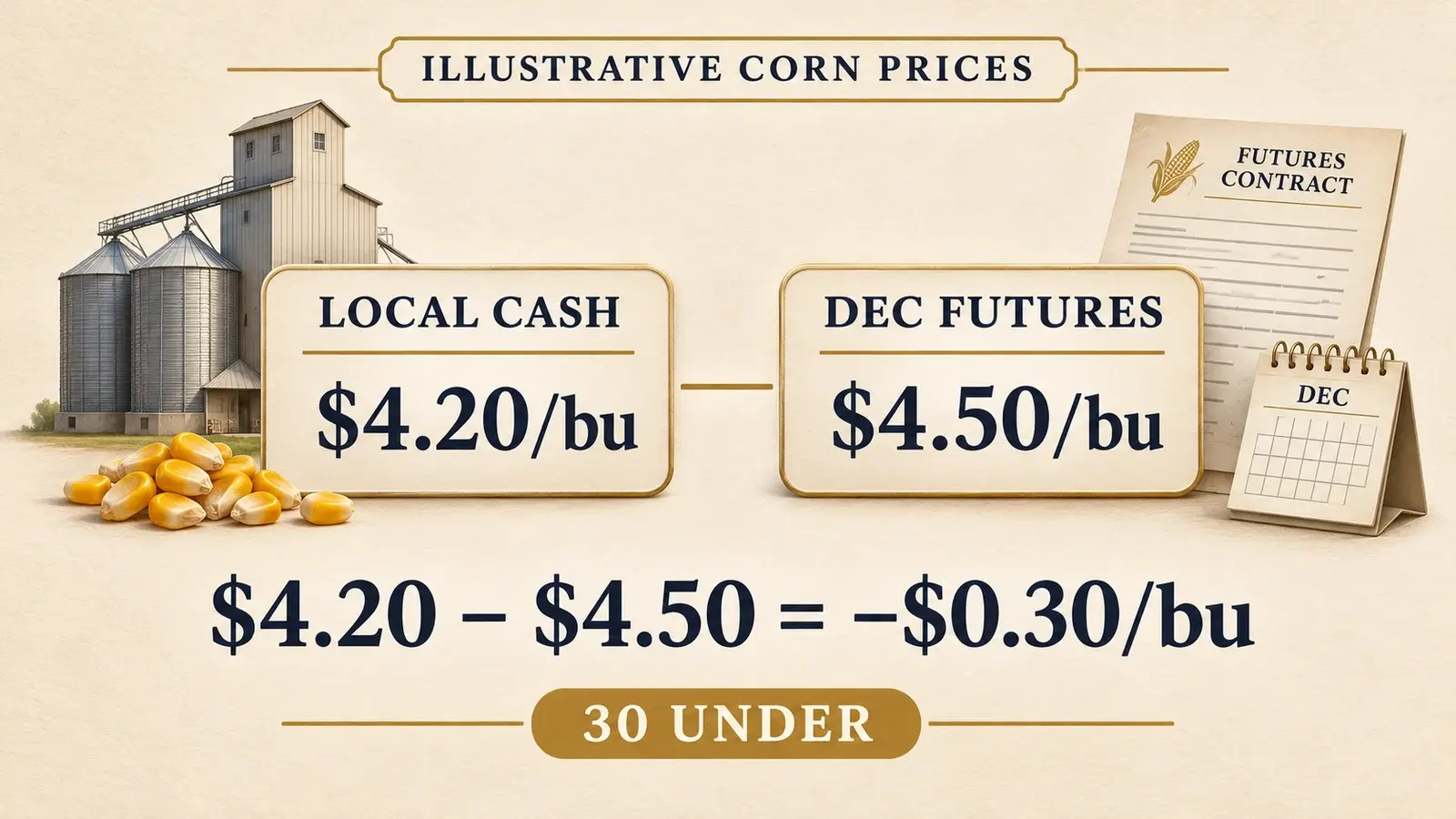
A negative basis means cash is below futures; a positive basis means cash is above futures. If the cash bid were $4.65 against the same $4.50 December contract, the basis would be +$0.15 per bushel, or “15 over December.” This article uses the grain-market cash-minus-futures convention.
Specify the location, delivery period and contract month
A usable basis quote identifies the commodity and grade, local buyer or market, cash delivery period, futures month and price units. Compare prices observed at the same time. For a forward cash bid, use the delivery period and futures month that the buyer's quote references.
Freight, handling, storage, quality and local supply and demand help explain why a local bid differs from exchange futures. There is no single local cash basis for every corn seller.
Changing the futures reference also changes the calculation. At one instant, a $4.20 cash bid is 30 under December futures at $4.50, but 40 under March futures at $4.60. Those hypothetical quotes describe the same cash bid. Switching the reference month alone does not show that the local buyer cut its price.
Sources: University of Missouri Extension: An Introduction to Basis · CME Group: Learn about Basis — Grains
A stronger basis does not require a rising cash price
Basis strengthens when it becomes more positive or less negative. Moving from 30 under to 10 under is a strengthening of 20 cents per bushel. Moving from 30 under to 40 under is a weakening of 10 cents.
Keep the same corn grade, location, delivery terms and December reference. If cash falls from $4.20 to $3.90 while futures fall from $4.50 to $4.00, basis strengthens from −$0.30 to −$0.10. Cash fell 30 cents, but futures fell 50 cents. “Stronger basis” describes the relative price change, not a higher outright cash price.
Sources: University of Missouri Extension: An Introduction to Basis
Why basis risk remains after a futures hedge
Consider a producer expecting to sell corn who sells December futures at $4.50 per bushel. An expected basis of 30 under implies a net selling price of $4.20. For this simplified short hedge, assume the futures position exactly matches the cash quantity and is bought back when the grain is sold. Exclude fees, slippage, financing and storage costs.
In each alternative outcome below, December futures are $4.00 when the producer sells the corn and closes the hedge. The short futures gain is $4.50 − $4.00 = $0.50 per bushel. Add that gain to the actual cash sale price.
The stronger basis produces a net selling price 20 cents above the original expectation; the weaker basis leaves it 10 cents below. Algebraically, cash sale price + futures gain = closing futures price + closing basis + opening futures price − closing futures price = opening futures price + closing basis. The futures price movement cancels in this matched example; the closing basis is still uncertain.
A buyer using a long hedge has the opposite exposure: a weaker-than-expected basis lowers its net purchase cost, while a stronger basis raises it. These are physical-commodity hedge examples, not a return forecast for a standalone futures position.
| Basis at sale | Cash sale / bu | Futures gain / bu | Net selling price / bu |
|---|---|---|---|
| 30 under (as expected) | $3.70 | +$0.50 | $4.20 |
| 10 under (stronger) | $3.90 | +$0.50 | $4.40 |
| 40 under (weaker) | $3.60 | +$0.50 | $4.10 |
Sources: CME Group: Selling Futures for Protection Against Falling Prices · CME Group: Learn about Basis — Grains
Convergence does not make every local basis zero
Delivery and arbitrage connect grain futures with the cash market as the delivery month approaches. That does not make every local elevator bid equal to futures. Location, quality and storage differences still matter; CME notes that even the delivery market can have a cash/futures difference associated with storage.
When evaluating a quoted basis, compare it with records for the same local market, commodity, delivery season and futures reference. A historical average can help form an expectation, but it is not a guaranteed sale price or a promise that basis will return to that average.
Sources: CME Group: Learn about Grain Convergence · University of Missouri Extension: An Introduction to Basis