Futures education
Contango vs backwardation on a futures curve
December and March oil can both fall by $2 a barrel while March keeps its $2 premium. The delivery dates tell you how to read that spread.
Compare delivery dates at the same moment
Contango means later delivery costs more than immediate delivery. Backwardation means later delivery costs less. Traders also use these terms for two futures months. If March oil costs more per barrel than December oil at the same time, the December-to-March interval is in contango. If March costs less, it is in backwardation.
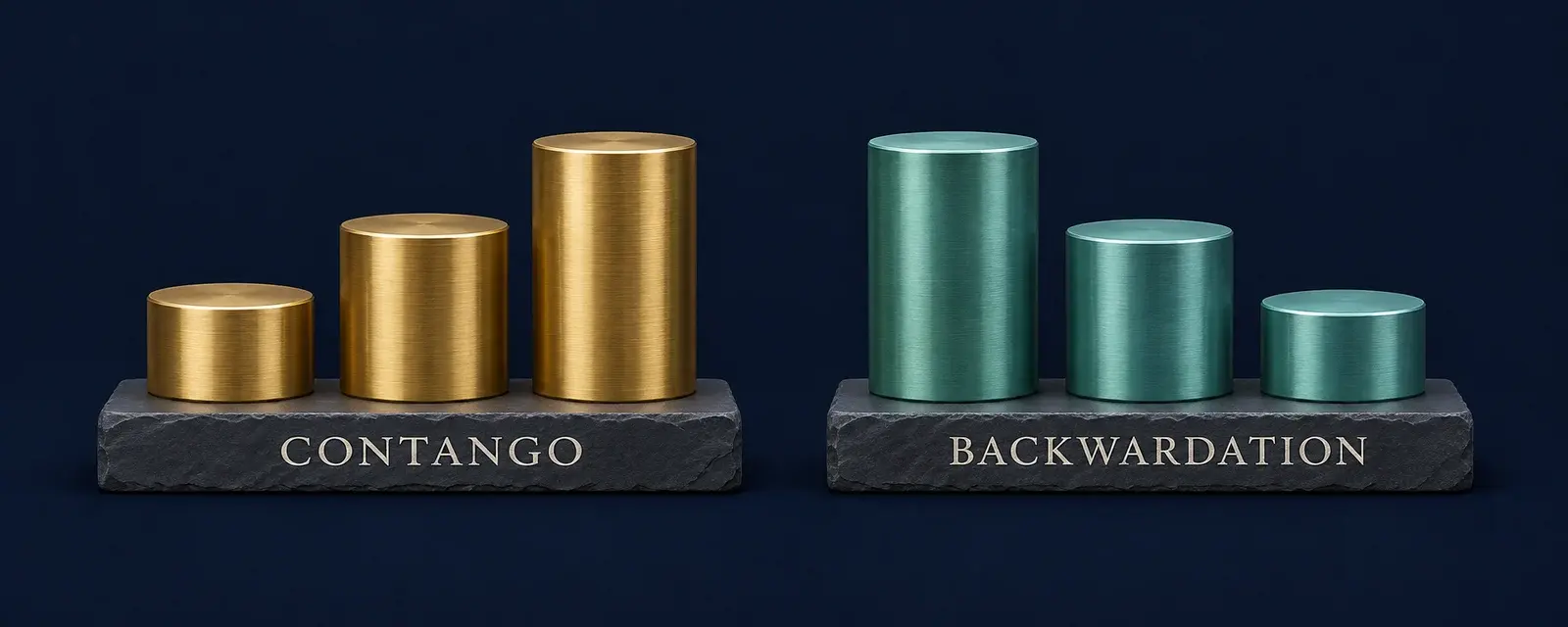
Spot is the cash price for immediate delivery. For a spot comparison, match the commodity, grade, location and units to the contract. For a futures-only comparison, name both months. A curve can rise from December to January and fall from January to March, so one label may describe only part of it.
Sources: CME Group on contango and backwardation · EIA on monthly natural gas futures curves · CME Group on convergence in grain markets
A $2 contango can survive a $2 price drop
These hypothetical oil quotes are in dollars per barrel for the same grade and location. Each row is a snapshot. Subtract December 2026 from March 2027 to measure the premium for later delivery. EIA uses this later-minus-nearer convention for its WTI spread. Reversing the subtraction reverses the sign.
From November 2 to November 3, both futures prices drop by $2. March still costs $2 more than December, so that part of the curve stays in contango. On November 4, March costs $2 less than December. That pair is now in backwardation.
| Illustrative date | Spot | Dec 2026 | Mar 2027 | March minus December |
|---|---|---|---|---|
| Nov 2, 2026 | $70 | $71 | $73 | +$2 |
| Nov 3, 2026 | $68 | $69 | $71 | +$2 |
| Nov 4, 2026 | $73 | $72 | $70 | −$2 |
Sources: EIA on oil inventories and futures spreads · EIA on monthly natural gas futures curves
What the price gap pays for
On the first row, a merchant who can buy the physical oil for $70 and lock in a March sale at $73 has a $3 spread per barrel to cover the cost of carrying it. If storage, financing and insurance through delivery total $3.40 per barrel, the spread falls $0.40 short even before transport or trading fees.
Immediate supply also has value. A refiner with oil on hand can keep operating through a supply interruption. Economists call that benefit of holding physical inventory the convenience yield. When prompt barrels are scarce, a buyer may pay more for them than for oil deliverable later.
Sources: CME Group on contango and backwardation · EIA on oil inventories and futures spreads
Which prices converge at expiry?
Delivery links an expiring physical futures contract to the cash market for the commodity it specifies. As March delivery approaches, compare the March futures price with the cash price then prevailing for the deliverable grade and location. Both can move between November and March. The $73 March quote in the first row therefore leaves the eventual March cash price open.
A local cash bid can still differ from the expiring futures quote. CME’s grain example illustrates why. Freight, handling and quality affect what a particular buyer will pay even as prices in the delivery market draw closer together.
Sources: CME Group on convergence in grain markets · CME Group on contango and backwardation