Futures education
Treasury futures conversion factors and the delivery invoice
The short can choose among eligible Treasury notes for delivery. Each note has a conversion factor that adjusts what the assigned buyer pays for it.
Find the factor for the note and delivery month
A Treasury futures conversion factor translates the futures settlement price into the principal due for a particular deliverable note. CME bases the factor on what $1 of the note’s face value would be worth at a hypothetical 6% yield, using its coupon and remaining maturity. The note’s actual coupon and market yield can differ from 6%.
For the standard 10-Year T-Note contract (ZN), first identify the eligible note and the delivery month. In CME’s spreadsheet, open the “10-Year Note Table.” Find the note’s coupon down the left and its remaining term across the top. Measure that term from the first day of the delivery month and round down to the nearest three-month increment. The intersection gives the four-decimal factor. It stays fixed for that delivery cycle even as market prices move. One ZN contract delivers $100,000 face value of a single eligible issue.
Sources: CME Group’s Treasury conversion factor lookup tables · How CME calculates U.S. Treasury futures conversion factors · CBOT Rule 19101 on deliverable notes and the invoice amount (PDF)
Calculate a 10-Year T-Note delivery invoice
For one ZN contract, multiply the applicable futures settlement in points by the note’s conversion factor and by $1,000. Round this principal to the nearest cent for each contract lot, rounding a half-cent up. Then add dollar accrued interest on the lot from the last coupon date up to, but excluding, the delivery date. The $1,000 multiplier is the value of one point, or 1% of the contract’s $100,000 face value.
If the short declares intent before the last trading day, use that day’s daily settlement. If the short declares intent on or after the last trading day, use the final settlement.
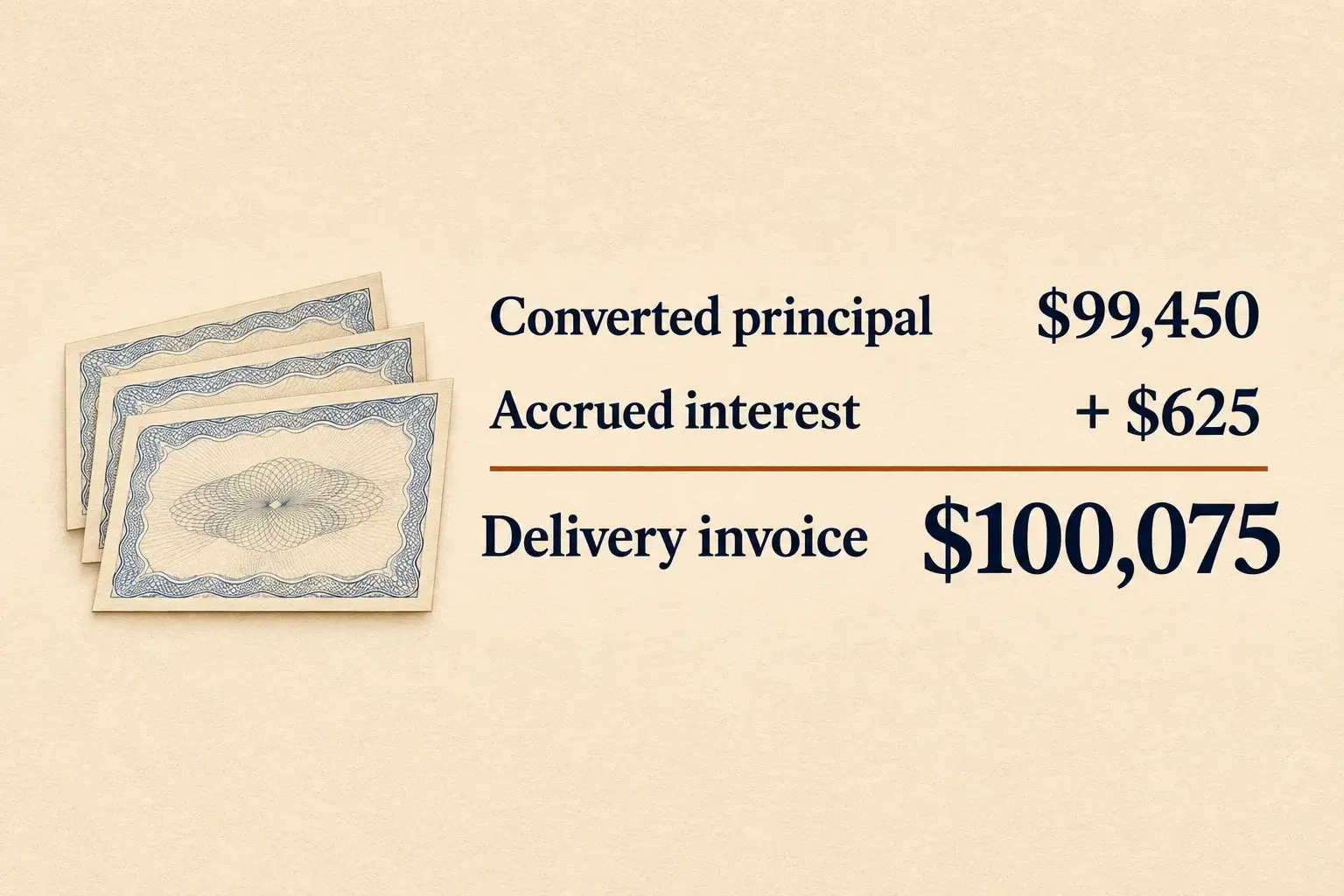
Suppose the short declares intent before the last trading day and that day’s settlement is 110-16, or 110.50 points. Assume the note’s factor is 0.9000 and accrued interest for the entire lot is $625. All three inputs are illustrative.
| Invoice component | Calculation | Dollars |
|---|---|---|
| Converted principal | 110.50 × 0.9000 × $1,000 | $99,450 |
| Accrued interest | Given for the $100,000 face amount | $625 |
| Buyer pays on delivery | $99,450 + $625 | $100,075 |
Sources: CBOT Rule 19101 on deliverable notes and the invoice amount (PDF) · CME Group’s Treasury futures delivery process, section on invoicing (PDF)
Which eligible note is cheapest to deliver?
Compare what the short would pay for each note with what it would bring on delivery. A larger conversion factor raises the invoice principal at a given futures price, but the note can also cost more to buy.
Take the same 110.50 settlement and compare two eligible issues purchased for same-day delivery. The purchase costs and converted principal amounts below exclude interest and cover $100,000 face value. For each note, the accrued interest paid to its seller is also received on delivery. With financing and transaction costs excluded, it cancels from this comparison.
Issue A costs $2,060 more to buy, yet it costs the short $150 less to deliver. Its higher conversion factor more than offsets the difference in purchase price.
| Eligible issue | Clean purchase cost | Converted principal | Cost above principal |
|---|---|---|---|
| A · factor 0.9000 | $99,500 | $99,450 | $50 |
| B · factor 0.8800 | $97,440 | $97,240 | $200 |
Sources: CME Group on cheapest-to-deliver securities and implied repo (PDF)
When the purchase and delivery dates differ
A short who buys a note ahead of delivery must finance the purchase and may receive a coupon before delivering it. To compare the eligible notes for the same delivery date, calculate the implied repo rate for each. This is the annualized return implied by buying that note for cash and delivering it against the futures contract. The highest implied repo rate generally identifies the cheapest issue to deliver. Coupon timing can change the ranking suggested by clean prices alone.
Sources: CME Group on cheapest-to-deliver securities and implied repo (PDF)