Futures education
Treasury futures price quotations: points, 32nds and ticks
A fractional quote tells you the price. The contract specification tells you what its smallest change is worth in dollars.
110-165 means 110 points plus 16½ thirty-seconds
In the fractional Treasury futures notation shown by CME, 110-165 means 110 + 16/32 + 1/64 = 110.515625 points. The digits after the hyphen are fractions of a point, not decimal digits: reading the quote as 110.165 gives the wrong price.
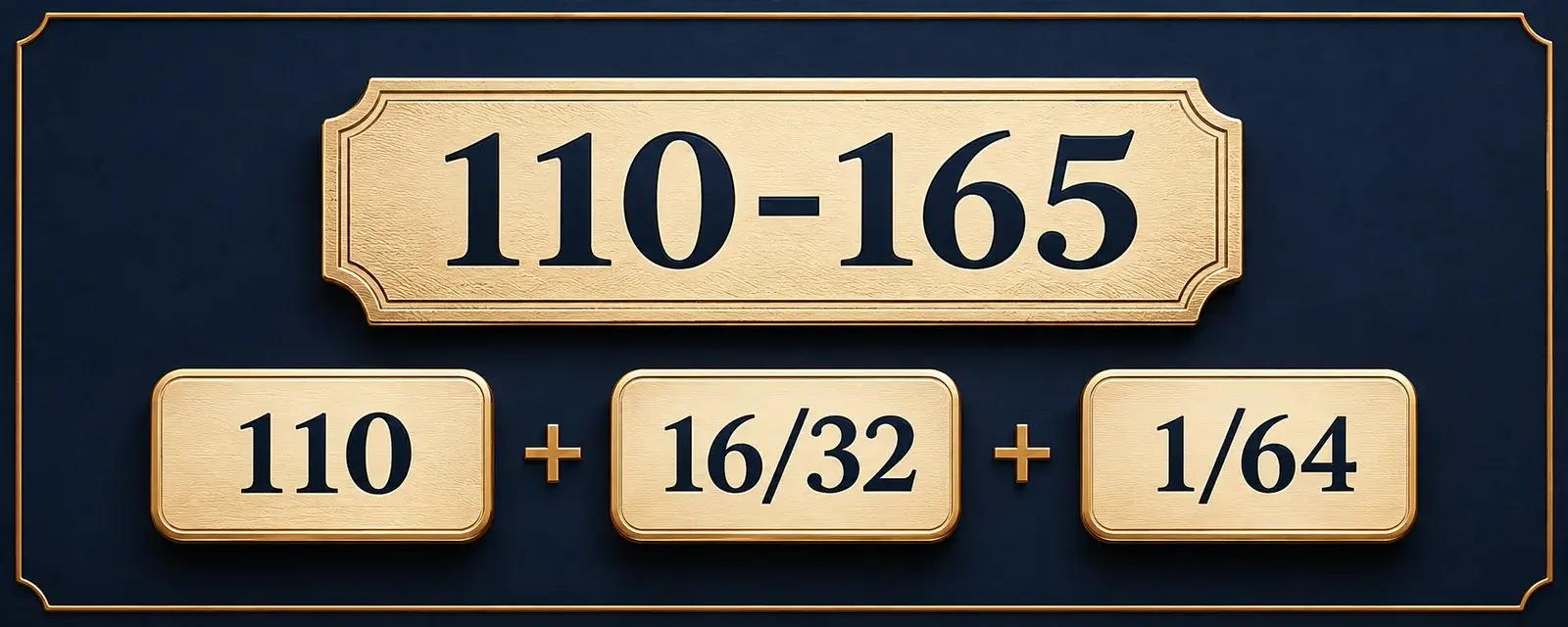
The first two digits after the hyphen count thirty-seconds, from 00 through 31. A third digit can encode a fraction of one thirty-second. In 110-165, the final 5 means half of 1/32, or 1/64. One whole price point represents 1% of par; its dollar value depends on the contract.
Sources: CME: Calculating U.S. Treasury pricing · CME: Understanding Treasury futures, quotation conventions · CBOT Chapter 19: 10-Year U.S. Treasury Note futures · CBOT Chapter 21: 2-Year U.S. Treasury Note futures
A trailing 2, 5 or 7 encodes part of a thirty-second
CME illustrates quarter-thirty-second notation with final digits 2, 5 and 7 for one-quarter, one-half and three-quarters of a thirty-second. The table uses that convention, which fits the 5-Year T-Note contract’s outright price increment. It is not a list of valid order prices for every Treasury contract.
A plus sign can express the same half-thirty-second amount in a cash Treasury quote: 110-16+ and the futures-style 110-165 represent the same numerical price. That notation equivalence does not make a cash security and a futures contract interchangeable.
| Fractional quote | Point calculation | Decimal points |
|---|---|---|
| 110-160 | 110 + 16/32 | 110.5 |
| 110-162 | 110 + 16/32 + 1/128 | 110.5078125 |
| 110-165 | 110 + 16/32 + 1/64 | 110.515625 |
| 110-167 | 110 + 16/32 + 3/128 | 110.5234375 |
Sources: CME: Calculating U.S. Treasury pricing · CME: Understanding Treasury futures, quotation conventions · CBOT Chapter 20: 5-Year U.S. Treasury Note futures
Match the price increment to ZB, ZN, ZF or ZT
A tick is the contract’s minimum price increment. The CBOT rules below specify outright trades, meaning a single contract month rather than an intermonth spread. The 30-Year Bond, 10-Year Note and 5-Year Note contracts each represent $100,000 face value; the 2-Year Note represents $200,000.
Dollar tick value equals the point increment multiplied by dollars per point. ZF and ZT both have a $7.8125 outright tick, but ZT has twice the dollar value per point and half the point increment. Do not round $15.625 to $15.63 before multiplying a ZN tick count: retain the full value through the calculation.
Spread increments can differ from outright increments. For example, Chapter 19 permits a ZN intermonth spread increment of 1/128 point, worth $7.8125, compared with 1/64 and $15.625 for an outright. Confirm the instrument and order type before applying the table.
| Contract | Dollars per point | Outright tick in points | Dollars per tick |
|---|---|---|---|
| ZB · 30-Year U.S. Treasury Bond | $1,000 | 1/32 | $31.25 |
| ZN · 10-Year U.S. Treasury Note | $1,000 | 1/64 | $15.625 |
| ZF · 5-Year U.S. Treasury Note | $1,000 | 1/128 | $7.8125 |
| ZT · 2-Year U.S. Treasury Note | $2,000 | 1/256 | $7.8125 |
Sources: CME: Basics of U.S. Treasury futures · CBOT Chapter 18: U.S. Treasury Bond futures · CBOT Chapter 19: 10-Year U.S. Treasury Note futures · CBOT Chapter 20: 5-Year U.S. Treasury Note futures · CBOT Chapter 21: 2-Year U.S. Treasury Note futures
Worked example: 110-315 to 111-005 in ZN
Suppose a hypothetical long position of two ZN contracts opens at 110-315 and closes at 111-005. Convert each fill before subtracting: the entry is 110 + 31/32 + 1/64 = 110.984375; the exit is 111 + 0/32 + 1/64 = 111.015625.
The increase is 111.015625 − 110.984375 = 0.03125 point, or 1/32. That equals two ZN outright ticks. Gross profit is 2 ticks × $15.625 × 2 contracts = $62.50, before commissions and fees. A short position over those same entry and exit prices would have a $62.50 gross loss.
Use the actual entry and exit fills in this calculation. The hyphenated quote strings are not base-ten numbers you can subtract directly; converting first also handles the change from 31 thirty-seconds to the next whole point.
Sources: CME: Calculating U.S. Treasury pricing · CBOT Chapter 19: 10-Year U.S. Treasury Note futures