Futures contracts
6E vs M6E futures: euro quotes, contract sizes and ticks
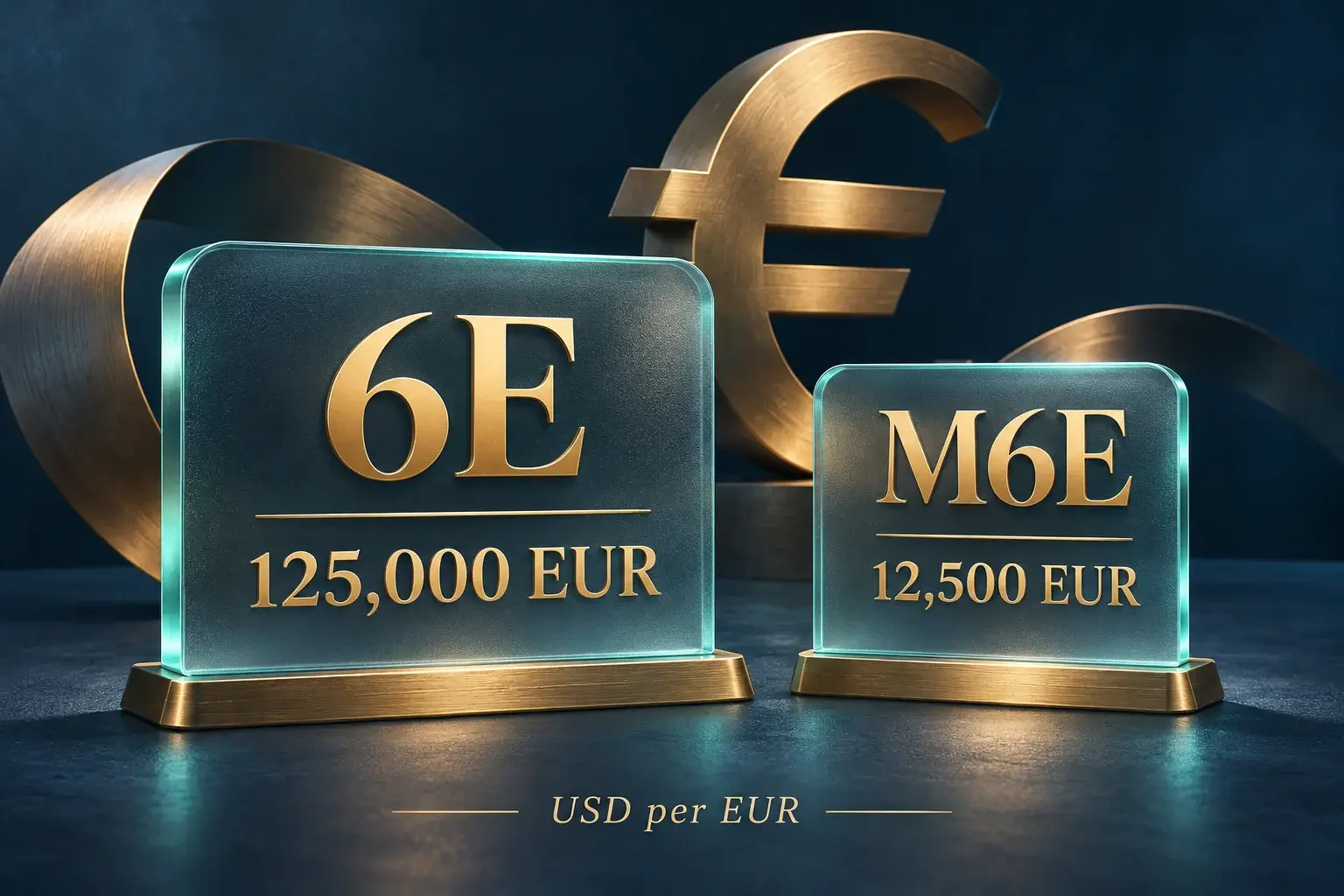
One 6E contract represents 125,000 euros; one M6E represents 12,500 euros. M6E has one-tenth the euro exposure, but its minimum price increment is twice as large. Compare the same exchange-rate move, rather than the same number of ticks.
Read the quote in dollars per euro
Both contracts quote U.S. dollars per euro. A hypothetical futures price of 1.0800 means $1.08 per euro for that contract. A higher quote means a more valuable euro relative to the dollar; a lower quote means a less valuable euro.
A long position gains from a rise in its futures price and loses from a fall, before costs. A short position has the opposite exposure. Keep the quote direction straight: these contracts are not quoted as euros per dollar.
Sources: CME FX product guide: Euro FX and Micro EUR/USD specifications
Contract size and tick value
The table uses outright futures trades on CME Globex. A tick is the minimum permitted price increment; its dollar value is the increment multiplied by the contract’s euro amount.
| Specification | Euro FX (6E) | Micro EUR/USD (M6E) |
|---|---|---|
| Euros per contract | 125,000 EUR | 12,500 EUR |
| Quote unit | USD per EUR | USD per EUR |
| Minimum outright price increment | 0.00005 | 0.0001 |
| Dollar value of one tick | 0.00005 × 125,000 = $6.25 | 0.0001 × 12,500 = $1.25 |
| Final settlement | Physical delivery | Physical delivery |
Sources: CME FX product guide: Euro FX and Micro EUR/USD specifications · CME Rulebook Chapter 261: Euro/U.S. Dollar futures · CME Rulebook Chapter 292: Micro Euro/U.S. Dollar futures
One pip is two 6E ticks
Using 0.0001 as one EUR/USD pip, a one-pip move is two 6E ticks but only one M6E tick. It changes one 6E contract’s value by $12.50 and one M6E contract’s value by $1.25. The 10:1 exposure ratio therefore holds per pip, even though the dollar values of one tick have a 5:1 ratio.
This also changes valid order prices. For an outright 6E order, 1.08005 lies on the permitted grid. For M6E, the adjacent permitted prices are 1.0800 and 1.0801; 1.08005 does not fit its increment. When moving an entry or stop calculation between contracts, check the actual price distance after choosing a valid order price.
Do not apply a spread or ClearPort increment to an ordinary outright Globex order. CME specifies separate 6E increments for those transaction types.
Sources: CME Rulebook Chapter 261: Euro/U.S. Dollar futures · CME Rulebook Chapter 292: Micro Euro/U.S. Dollar futures
Calculate P/L from the same price move
For a long position, gross P/L in dollars = (exit price − entry price) × euros per contract × number of contracts. For a short position, reverse the price subtraction.
Suppose a long position is opened at 1.0800 and closed at 1.0820. These are hypothetical fills, and the price difference is 0.0020, or 20 pips.
- Ten M6E contracts would produce $250 for the same assumed entry and exit prices. That arithmetic does not establish equal commissions or identical execution prices.
- A fall from 1.0800 to 1.0780 would instead lose $250 on one long 6E or $25 on one long M6E, before costs.
- Subtract the applicable commissions and fees from gross P/L. Use actual fill prices when recording results; a planned stop price does not guarantee the eventual exit price.
| Position | Ticks moved per contract | Gross P/L |
|---|---|---|
| 1 × 6E | 0.0020 ÷ 0.00005 = 40 | 0.0020 × 125,000 = $250 |
| 1 × M6E | 0.0020 ÷ 0.0001 = 20 | 0.0020 × 12,500 = $25 |
Sources: CME Rulebook Chapter 261: Euro/U.S. Dollar futures · CME Rulebook Chapter 292: Micro Euro/U.S. Dollar futures
Both contracts have physical delivery
M6E’s smaller size does not make it cash-settled. Both CME rule chapters specify physical delivery. Their usual last trading day is the second business day before the third Wednesday of the contract month, with banking and settlement-system holiday adjustments. Consult the rules and the exact expiring contract’s calendar rather than assuming every expiry falls on Monday.
Broker or prop-program permissions and closeout deadlines are separate from these exchange rules. Confirm the enabled product, contract month and account deadline before placing an order; an exchange specification alone does not establish what your account allows.
Sources: CME Rulebook Chapter 261: Euro/U.S. Dollar futures · CME Rulebook Chapter 292: Micro Euro/U.S. Dollar futures