Futures education
CL vs MCL crude oil futures: ticks, size and settlement
Ten MCL contracts have the same barrel exposure as one CL, but their settlement method and last trading day differ.
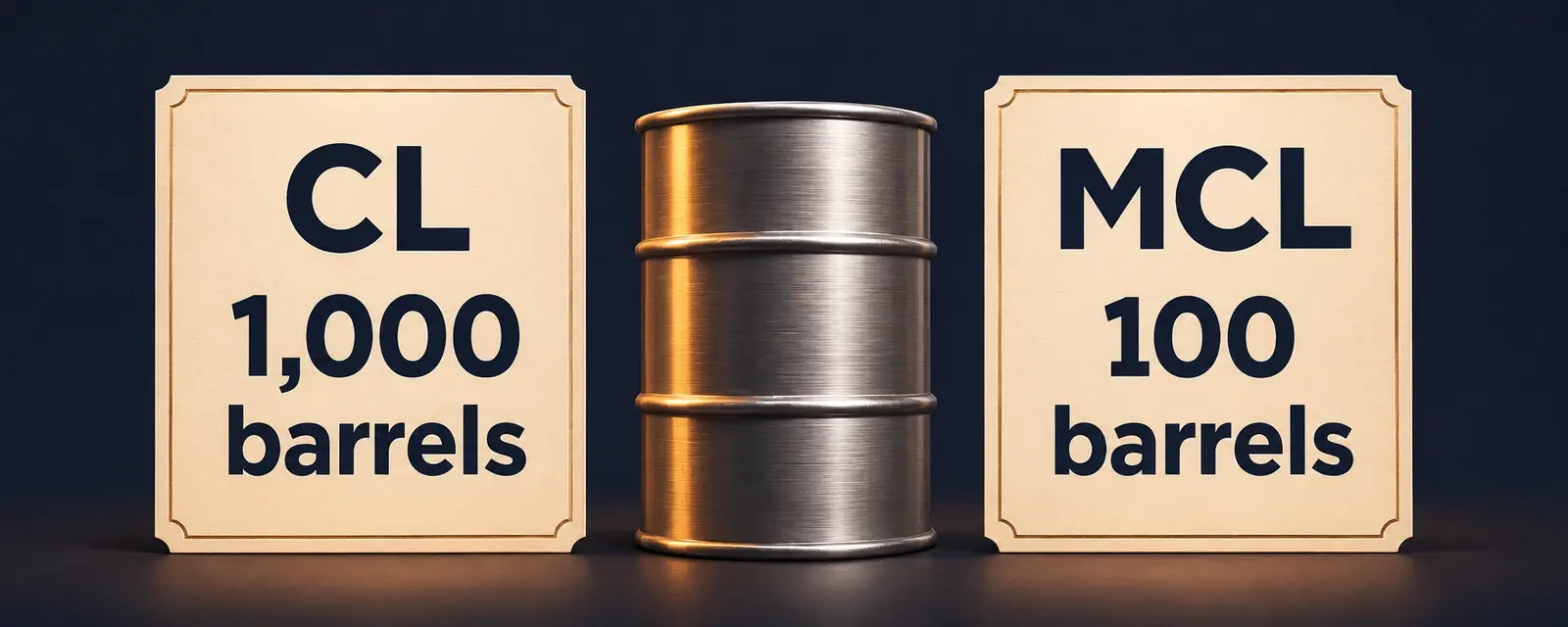
CL is 1,000 barrels; MCL is 100
CL is the standard NYMEX WTI crude oil futures contract, covering 1,000 barrels. MCL is Micro WTI, covering 100 barrels. Both quote prices in U.S. dollars and cents per barrel, so the same price change produces ten times as much dollar profit or loss on one CL as on one MCL.
The dollar tick value is the minimum price step multiplied by the barrel quantity. CL and MCL both move in $0.01-per-barrel increments: $0.01 × 1,000 = $10 for CL, while $0.01 × 100 = $1 for MCL. The table describes one contract.
| Measure | CL | MCL |
|---|---|---|
| Barrels per contract | 1,000 | 100 |
| Minimum price step | $0.01 per barrel | $0.01 per barrel |
| Dollar value of one tick | $10 | $1 |
| Dollar value of a $1-per-barrel move | $1,000 | $100 |
Sources: NYMEX Chapter 200: Light Sweet Crude Oil futures · NYMEX Chapter 309: Micro WTI Crude Oil futures · CME: WTI futures contract comparison
A 20-cent move: $200 on CL or $20 on MCL
Suppose a hypothetical long position opens at $70.00 per barrel and closes at $69.80. The adverse move is $0.20 per barrel, or 20 ticks. Gross loss equals $0.20 × barrels per contract × number of contracts, before commissions and fees.
Four MCL contracts provide 400 barrels of exposure and lose $80 in this example. Ten MCL provide 1,000 barrels and lose $200, matching one CL for this identical price move. That is exposure equivalence, not a promise of identical execution or total costs: compare the actual fills and the fees for ten contracts with those for one.
The calculation assumes the stated entry and exit fills. A stop trigger does not guarantee an exit at that price: CME distinguishes a stop-limit order, which becomes a limit order, from a stop with protection, which can execute only within its protection range. A planned 20-cent exit distance is therefore not a guaranteed maximum loss.
Sources: NYMEX Chapter 200: Light Sweet Crude Oil futures · NYMEX Chapter 309: Micro WTI Crude Oil futures · CME: Futures order types
MCL settles in cash and expires earlier
CL has physical-delivery terms for crude oil in Cushing, Oklahoma. MCL instead settles in cash. Its final settlement uses the corresponding CL contract month's settlement price on MCL's last trading day; it is not a claim on physical barrels.
MCL trading ends one business day before the corresponding CL contract's termination date. Do not copy CL's last trading day onto MCL or treat “one business day” as a fixed 24 hours. Check the dated contract and your broker or account provider's earlier closeout deadline before holding near expiry.
These are exchange contract terms. They do not establish that an evaluation or simulated-funded account permits holding to expiration, delivers oil or grants a cash-settlement entitlement. The account provider's rules govern that account's trading access and withdrawals.
Sources: NYMEX Chapter 200: Light Sweet Crude Oil futures · NYMEX Chapter 309: Micro WTI Crude Oil futures
Check CL, MCL and QM separately
“Mini crude oil” can refer to a third contract: E-mini WTI, symbol QM. CME's comparison lists QM at 500 barrels with a $0.025-per-barrel tick worth $12.50 and financial settlement. It is neither CL nor MCL; choosing it changes both the size and the price increment.
When comparing CL with MCL, use the same delivery month and inspect each contract's bid, ask and available size. The ten-to-one barrel ratio converts dollar exposure; it does not make their order books interchangeable. Confirm the symbol, expiry, quantity and dollar value of the intended price move before sending an order.
Sources: CME: WTI futures contract comparison · CME: Futures order types