Trading rules
Futures prop firm drawdown: intraday, EOD and static limits
Trailing drawdown raises your loss floor as the account reaches qualifying highs. Intraday rules can count open profit; end-of-day rules use closing balances. A static floor stays fixed.
Start with the loss floor
The drawdown allowance is the distance used to set an account’s loss boundary. Remaining loss room is your current account equity (balance plus open profit or loss) minus that floor. Those amounts can differ after a trade gives back open profit or the floor stops trailing.
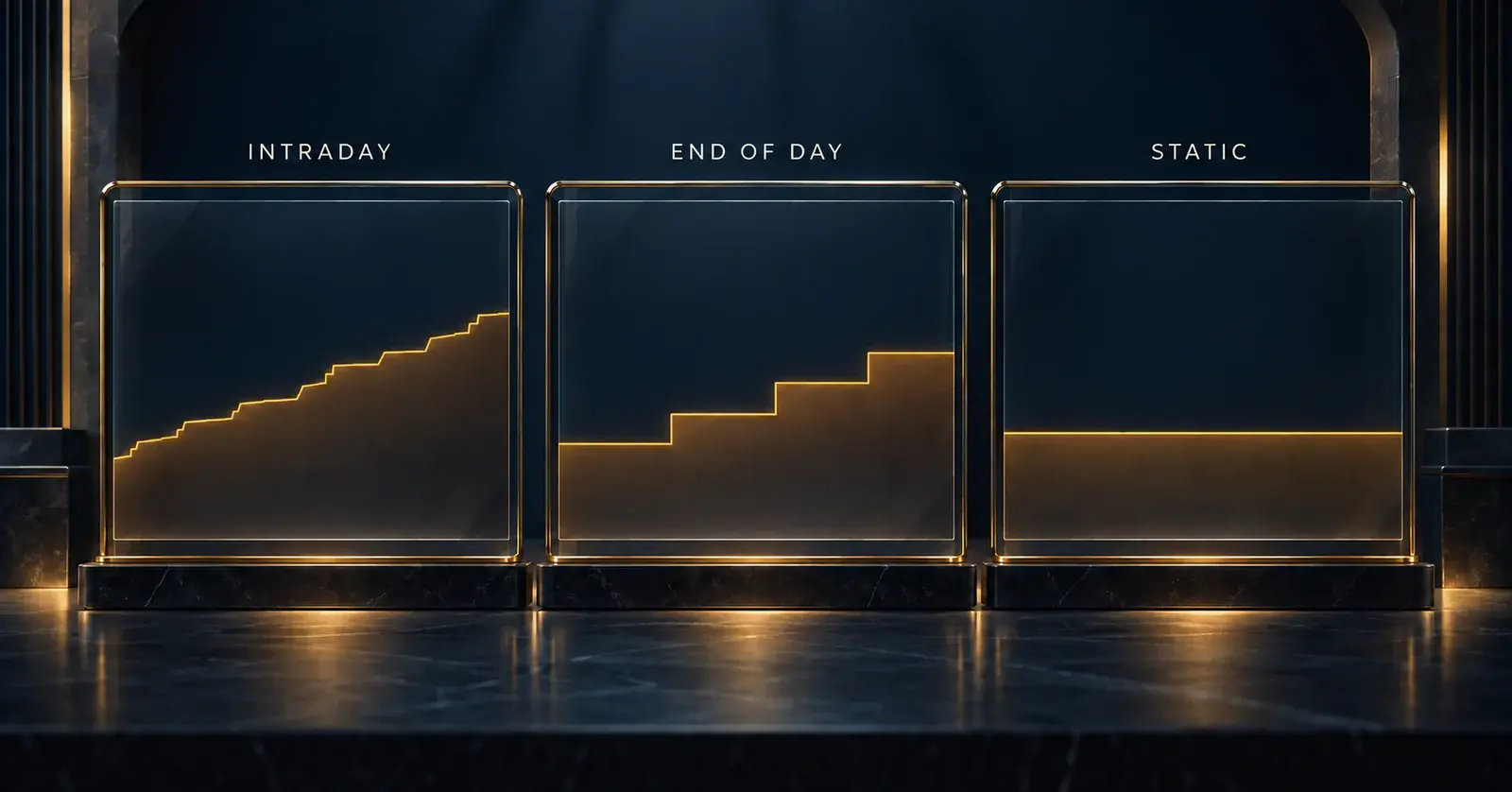
For the examples below, assume a simulated account starts at $50,000 with a $2,000 drawdown allowance and a $48,000 initial floor. There is no earlier higher balance, lock point, withdrawal, reset or stage change. Account values already include applicable trading costs; all positions close before the end-of-day calculation. These are hypothetical mechanics, not an advertised account offer.
Sources: Boxcar drawdown and Daily Loss Limits · Apex: intraday trailing drawdown explained
The same trade under three drawdown rules
Open profit lifts account equity to $51,500. The trade then closes, and the session ends at $50,600. The table calculates each floor and the remaining room after the session.
| Rule | Floor at the $51,500 open-profit peak | Floor after the $50,600 close | Remaining room after close |
|---|---|---|---|
| Intraday trailing | $51,500 − $2,000 = $49,500 | $49,500; the floor does not fall | $50,600 − $49,500 = $1,100 |
| End-of-day trailing | $48,000; no new closing high yet | $50,600 − $2,000 = $48,600 | $50,600 − $48,600 = $2,000 |
| Static | $48,000; fixed from the start | $48,000; unchanged | $50,600 − $48,000 = $2,600 |
Sources: Apex: intraday trailing drawdown explained · Tradeify: trailing max drawdowns · Apex legacy evaluation rules: static definition
Why a profitable trade can leave less room
The example earns $600 but gives back $900 from its open-profit peak. Under the intraday model, that giveback consumes loss room because the floor stays at its new high. The account ends profitable, yet has less room than it started with.
Apex’s intraday documentation explicitly includes unrealized gains in the high-water mark. Closing the trade or returning toward the starting balance does not move that threshold down. Check the current floor before sizing another trade; realized profit alone does not tell you the remaining allowance.
EOD calculation does not mean EOD enforcement
An end-of-day system separates the time the floor rises from the time the floor is enforced. Tradeify updates its trailing threshold from qualifying end-of-day balances while monitoring the current threshold against net liquidation value throughout the session.
In a separate example with the original $48,000 floor still active, an intraday fall to $47,900 crosses that boundary even if the trader hopes to recover before the close. Waiting for the EOD calculation does not suspend the current loss limit. Verify whether your provider’s breach trigger is touching the threshold or falling below it.
Sources: Tradeify: trailing max drawdowns · Boxcar drawdown and Daily Loss Limits
A static floor and a locked trailing floor start differently
A static floor is fixed from the beginning, so gains increase the distance above it without raising it. Apex describes this structure in its legacy static-account rules.
A trailing floor that later locks has already moved through earlier profits. Boxcar’s drawdown guide describes a lock after its initial trail condition is met and a separate payout-triggered lock for Scale. The lock level and trigger are part of the selected plan’s rules.
Record when the floor stops rising, how a payout changes the remaining balance and loss room, and whether the calculation changes between evaluation and simulated-funded stages. A withdrawal can reduce the distance above the floor even when the floor itself does not move.
Sources: Apex legacy evaluation rules: static definition · Boxcar drawdown and Daily Loss Limits
Keep the daily loss limit separate
A Daily Loss Limit is a separate session rule. At Boxcar, hitting it closes positions and stops trading until the next session; touching the Maximum Loss Limit breaches the account. The account floor still applies while the DLL is in force.
Before placing an order, compare the current loss floor, remaining DLL allowance where applicable, and permitted position size. Use the exact rules for your account stage rather than treating the headline account balance as spendable loss room.