Futures contracts
RTY vs M2K futures: tick values and Russell 2000 exposure
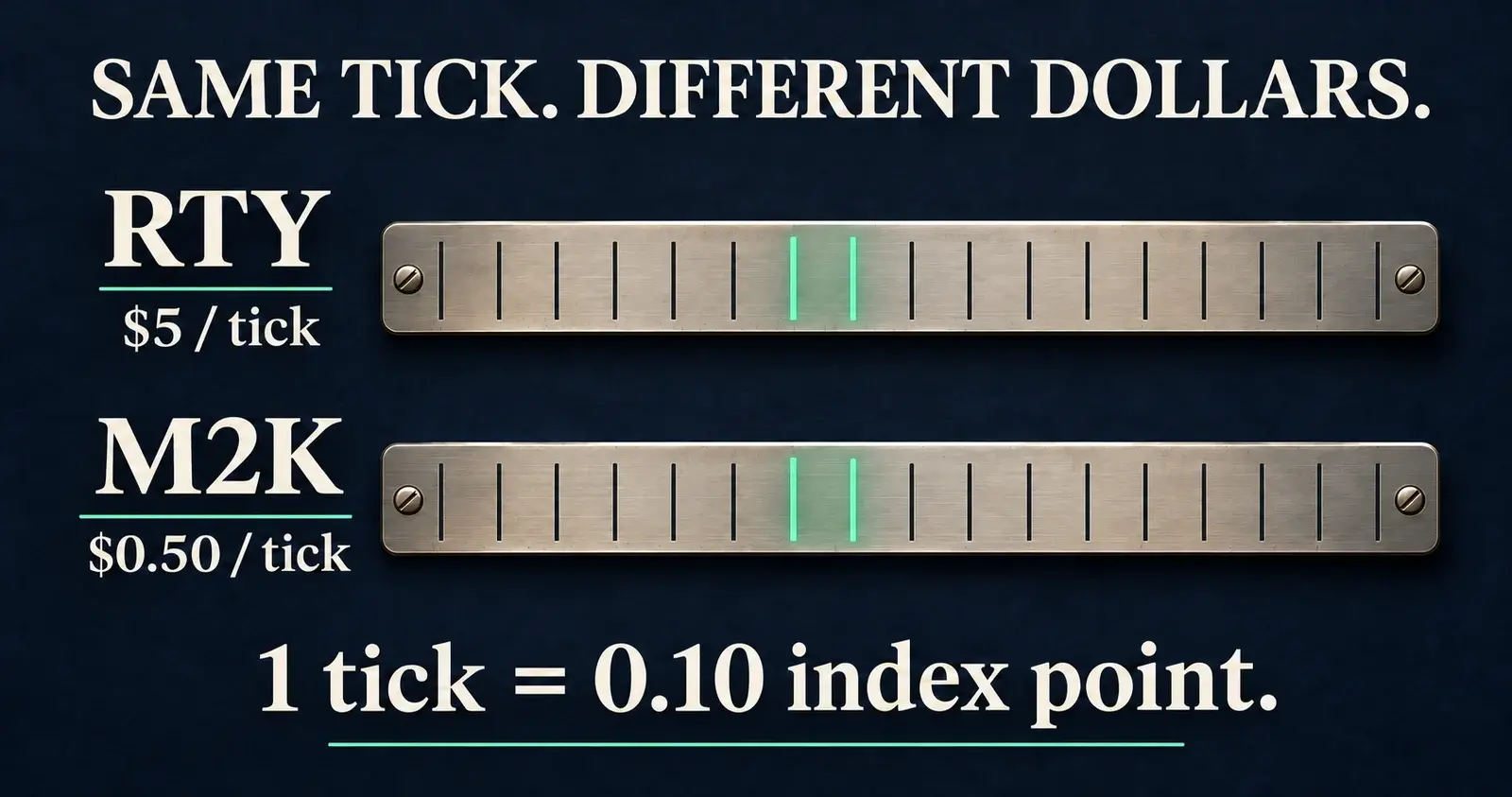
RTY moves $50 per Russell 2000 index point; M2K moves $5. Both outright contracts trade in 0.10-point ticks, worth $5 for RTY and $0.50 for M2K.
Same small-cap index, different dollar size
RTY is the E-mini Russell 2000 futures contract; M2K is its Micro E-mini counterpart. Both provide exposure to the Russell 2000, a benchmark for U.S. small-cap stocks. Changing from RTY to M2K reduces the contract multiplier; it does not switch the underlying index to the S&P 500 or Nasdaq-100.
| Contract detail | RTY | M2K |
|---|---|---|
| Multiplier per index point | $50 | $5 |
| Outright minimum price move | 0.10 point | 0.10 point |
| Dollar value of one outright tick | $5 | $0.50 |
| Outright ticks in one full point | 10 | 10 |
| Notional value at a hypothetical 2,000.0 price | $100,000 | $10,000 |
Sources: CME rulebook: E-mini Russell 2000 futures, Chapter 393 · CME rulebook: Micro E-mini Russell 2000 futures, Chapter 363 · CME introduction to E-mini Russell 2000 futures
An eight-point move is 80 ticks
Suppose a long position enters at 2,000.0 and exits at 1,992.0. The adverse move is 8.0 index points: 8.0 ÷ 0.10 = 80 ticks. These hypothetical losses use the stated fills and exclude commissions and other fees. A planned stop at 1,992.0 does not guarantee that exit price.
Calculate the loss either as points × dollars per point × contracts, or as ticks × dollars per tick × contracts. Do not multiply eight points by the tick value: that would understate the result tenfold.
MES and MNQ outright contracts use 0.25-point ticks, but Russell contracts use 0.10. Reusing a four-ticks-per-point setting from an MES/MNQ worksheet would also give the wrong RTY or M2K result.
| Position | Calculation using points | Gross loss |
|---|---|---|
| 1 RTY | 8 × $50 × 1 | $400 |
| 1 M2K | 8 × $5 × 1 | $40 |
| 3 M2K | 8 × $5 × 3 | $120 |
| 10 M2K | 8 × $5 × 10 | $400 |
Sources: CME rulebook: E-mini Russell 2000 futures, Chapter 393 · CME rulebook: Micro E-mini Russell 2000 futures, Chapter 363 · CME Micro E-mini equity futures specifications and settlement FAQ
Matching RTY exposure with M2K
Ten M2K contracts have the same combined dollar multiplier as one RTY. For the same contract month, direction and point movement, their gross price-move exposure matches. M2K also permits intermediate sizes such as the three-contract position above.
Compare the total round-trip cost of ten M2K contracts with one RTY, using your account’s current fee schedule. Matching multipliers does not establish equal fees, bid-ask spreads or available depth. Check the actual instrument and expiry you intend to trade.
These are separate contracts. An opposite M2K trade is not an ordinary closing order for an RTY position. CME describes a 10:1 offset process that a clearing broker can request; do not assume that process is automatically available in your account.
Notional value is price × multiplier. The $100,000 and $10,000 figures above are exposure calculations, not required deposits, account balances or maximum possible losses. Size a trade against its dollar risk and the account’s usable loss allowance.
Sources: CME Micro E-mini equity futures specifications and settlement FAQ
Cash settlement uses a special opening quotation
RTY and M2K follow the March, June, September and December quarterly cycle. Both settle in cash, using the same Russell 2000 Special Opening Quotation (SOQ) for the corresponding expiry. You do not receive a basket of stocks.
Normally the SOQ is determined on the third Friday of the contract month from component-stock opening prices. It is not simply the futures contract’s last traded price. The rulebooks specify adjustments for holidays and stocks that do not open or trade, so use the exchange’s contract calendar for the actual expiry.
Exchange settlement provisions do not grant permission to hold a position through expiry in a particular brokerage or prop account. Check that account’s earlier closeout or rollover requirements before carrying the expiring contract.
Sources: CME rulebook: E-mini Russell 2000 futures, Chapter 393 · CME rulebook: Micro E-mini Russell 2000 futures, Chapter 363 · CME Micro E-mini equity futures specifications and settlement FAQ