Firm comparisons
Lucid Trading vs Boxcar Trading: Flex rules and payout choices
LucidFlex’s checkout settings affect evaluation consistency and intraday payout access. BoxcarFlex uses one evaluation consistency setting. This comparison is written by Boxcar Trading from official rules checked October 20, 2026.
LucidFlex’s consistency option changes the evaluation
LucidFlex defaults to a 40% evaluation consistency limit, with a paid 50% option that includes a cushion. BoxcarFlex uses 50% plus a two-percentage-point cushion, allowing a best day up to 52% of total Eval net profit. Both $50K evaluations have a $3,000 profit target and a $2,000 maximum loss limit.
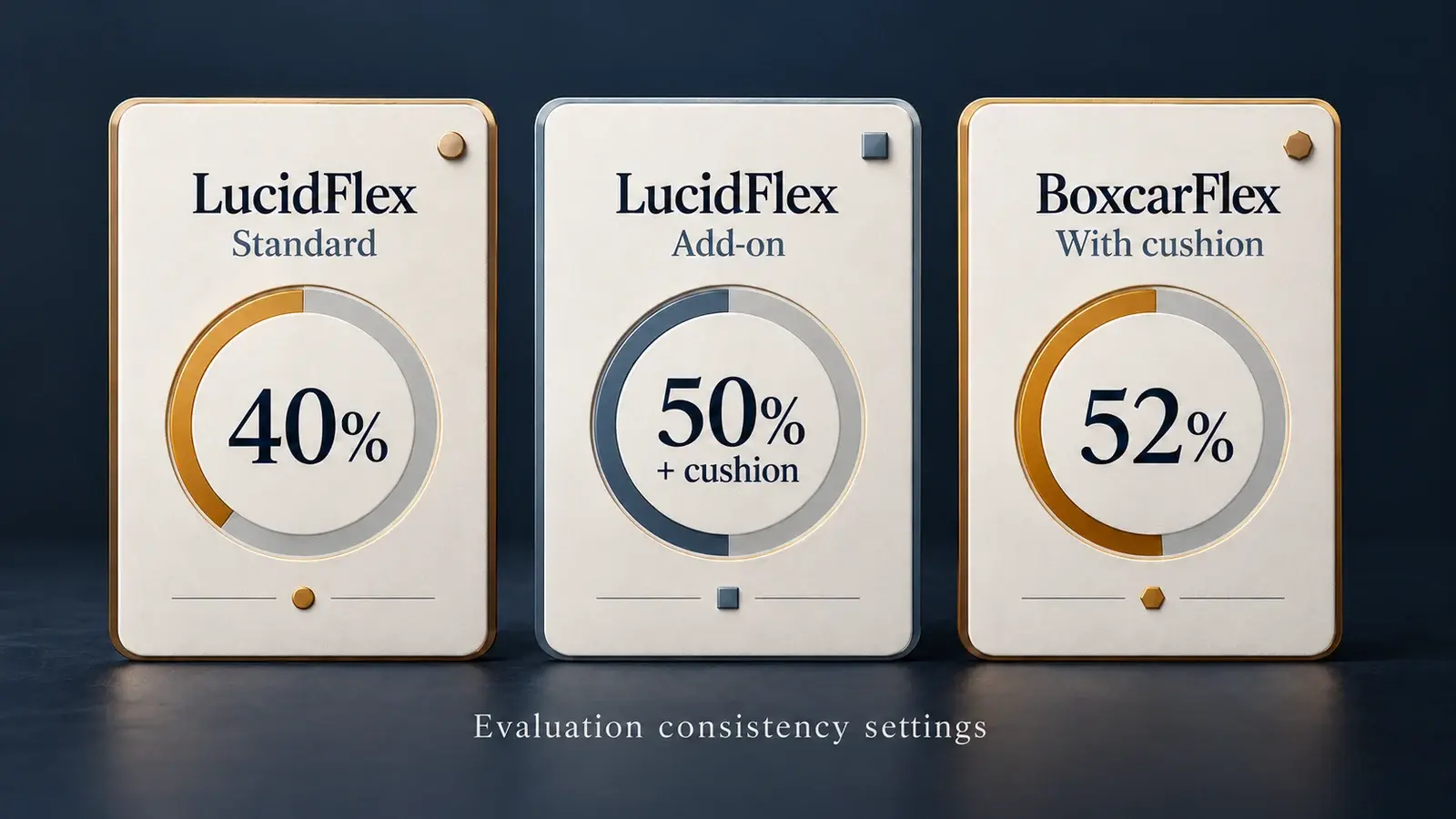
For a hypothetical $1,500 best day and $3,000 total profit, the ratio is 50%. That meets Lucid’s 50% option and BoxcarFlex’s ceiling. Lucid’s standard 40% setting instead requires at least $3,750 total profit while the best day stays $1,500: $1,500 ÷ 0.40 = $3,750.
Lucid’s cushion table gives a $1,560 best-day example at the $3,000 target for the 50% option, matching 52% in that example. Its guidance says the dollar cushion varies with actual profit; do not treat $1,560 as a fixed allowance at every balance. Lucid resets return to 40% consistency; retaining the 50% option requires a new evaluation purchase with the add-on.
Sources: LucidFlex: evaluation targets and fee basis · LucidFlex: consistency calculation and add-on cushion · LucidFlex: checkout settings and intraday payout conditions · BoxcarFlex: evaluation, scaling and payouts
Lucid’s daily loss limit also controls intraday payout access
On LucidFlex, enabling the Daily Loss Limit lowers the evaluation purchase price and carries that limit into the funded stage. Hitting the DLL pauses trading until the next session. With it enabled, an eligible funded trader may request an intraday payout using that session’s profit; Lucid then pauses trading on that account until the trading day ends. Accounts with a hedging violation cannot use this intraday option.
Turning the DLL off costs more and keeps payouts on Lucid’s regular end-of-day schedule. These purchase settings cannot be changed on an active account. BoxcarFlex also offers a lower-priced DLL configuration that carries from Eval into funded, but that price choice should not be interpreted as Lucid’s intraday payout feature.
Sources: LucidFlex: checkout settings and intraday payout conditions · BoxcarFlex: evaluation, scaling and payouts
The $50K first-payout requirements are similar
LucidFlex and BoxcarFlex both require five separate days of at least $150 profit on a $50K simulated-funded account, a positive payout cycle, a $500 minimum request and a 90% trader share. Neither has funded consistency or a retained payout buffer. The five-day requirement resets after an approved payout.
For a first payout with no prior withdrawals, assume five $400 net-profit days, no other gains or losses, and all other trading and eligibility conditions satisfied. Both accounts have $2,000 profit. Half is $1,000, below the $2,000 size-based cap, giving a $900 trader share before any payment-provider fees.
Lucid’s payout table describes the limit as 50% of profit; Boxcar specifies 50% of profit in the current payout cycle. A nominal $50,000 account balance is not withdrawable cash. The example uses a first cycle so it does not assume identical treatment of retained profits in later cycles.
Sources: LucidFlex: simulated-funded account · LucidFlex: payout eligibility and caps · BoxcarFlex: evaluation, scaling and payouts · Boxcar: payout eligibility and gross request amounts
No payout buffer still leaves a loss floor and position limit
Both Flex programs use end-of-day trailing drawdown and lock the $50K loss floor at $50,100 when a payout is requested. End-of-day tracking determines how the floor rises; touching the current floor can still breach the account during the session.
In the first-payout example, a $1,000 gross deduction from $52,000 leaves $51,000. That is only $900 above the $50,100 floor.
Both $50K funded scaling tables begin at two minis or 20 micros below $1,000 profit, move to three minis or 30 micros at $1,000–$1,999, and reach four minis or 40 micros at $2,000. Tiers update at session end and can fall after losses or payouts; the evaluation’s four-mini maximum is not the starting funded allowance.
Sources: LucidFlex: end-of-day drawdown and payout lock · LucidFlex: funded position scaling · BoxcarFlex: evaluation, scaling and payouts · Boxcar: payout eligibility and gross request amounts
LucidPro, LucidDaily and LucidDirect use different rules
On LucidPro’s $50K account, the retained buffer is $52,100. A $500 payout request therefore needs at least a $52,600 balance, alongside the other conditions. LucidFlex does not have that retained buffer.
| Program | Difference from LucidFlex |
|---|---|
| LucidPro | Payouts require 40% cycle consistency and profit above a retained buffer. |
| LucidDaily | Payouts use profit above the buffer and positive profit since the last request. Its $50K maximum daily simulated profit is $8,000; reaching that threshold triggers its move-to-live rule. |
| LucidDirect | Starts simulated-funded without an evaluation. It has its own loss and payout rules; skipping an evaluation does not mean starting in a live brokerage account. |
Sources: LucidPro: payout buffer and consistency · LucidDaily: payout requirements · LucidDirect: simulated straight-to-funded accounts
Compare the selected configuration and connection
LucidFlex evaluation fees are one-time purchases, without monthly rebilling or a funded activation fee. Boxcar Eval fees also do not renew automatically and have no Eval-to-funded activation charge. Lucid’s 50% add-on and each firm’s DLL selection affect the price, so compare the final totals for the same account size and chosen settings.
Lucid lists NinjaTrader, Tradovate and TradingView under CQG, with Rithmic options including Quantower, MotiveWave and Sierra Chart. Boxcar accounts use Rithmic. Platform, exchange-data or third-party connection charges may be separate from Boxcar’s account price; a matching platform name alone does not establish identical licensing or setup.
Sources: LucidFlex: evaluation targets and fee basis · LucidFlex: checkout settings and intraday payout conditions · Lucid: supported platforms and connections · Boxcar: account charges and resets · Boxcar: supported Rithmic platforms
Use Lucid’s current live structure, not its legacy Flex page
Lucid’s current live guide puts Flex, Pro and Direct traders in the review pool after the fifth payout, with earlier review possible under other criteria. Its risk team controls the transition. The fifth payout is a maximum payout level, not a promise of five payouts before review.
The current standard structure starts each eligible live account at a $0 balance; the $50K size has $2,000 of starting live drawdown. Funded accounts need at least one payout to qualify for a live account, and all simulated accounts close when the trader moves live or chooses cashout. Do not apply the separate legacy Flex profit-transfer caps to this structure.
BoxcarFlex also reaches live review after five approved payouts, with approval separate from the count. Remaining simulated profits are forfeited on the move live; an eligible final payout is settled separately.
Sources: Lucid: current live transition structure · BoxcarFlex: evaluation, scaling and payouts · Boxcar: choose a plan and account stage